
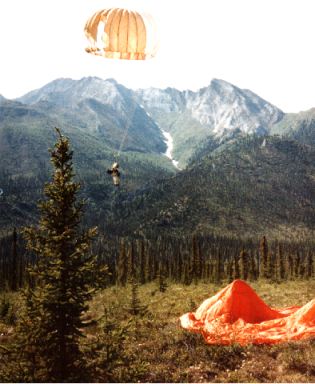
Fire in the Brooks Range, Alaska. FS-10 Parachute, early ’80s
I was an Alaska smokejumper for well over twenty years. On this page, I’d like to share a few pictures and a tell you a little bit about the “greatest job in the world.”
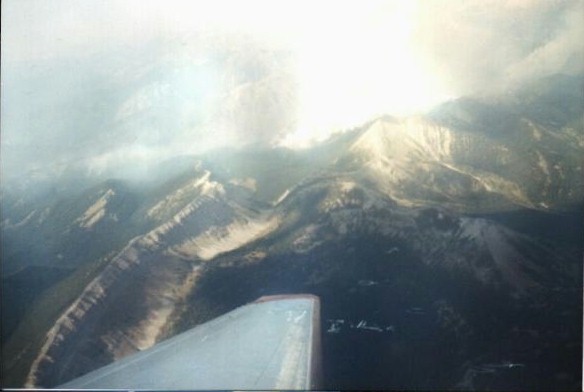
Although most fires can be reached by road or helicopter, smokejumpers flying in faster airplanes (this photo shows a picture of a DC-3 circling a fire on a fire run in the Bob Marshall Wilderness of Montana) and using specially designed parachutes can reach fires that are difficult to reach by any other method.
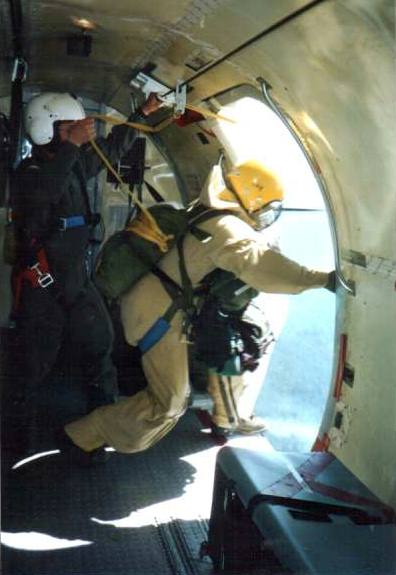
This was taken in a DC-3 over a fire in the rugged Cascade Mountains of southern Oregon. The jumper in the door is about ready to follow his jump partner who has just exited. The “spotter,” on the left, is making sure the jumper’s static line stays clear. The static line automatically deploys the main parachute of the Forest Service system. The yellow static line of the first jumper can be seen in the upper, left-hand corner of the door. On this fire both Forest Service and Bureau of Land Management firefighters safely jumped out of the same aircraft, business as usual nowadays.
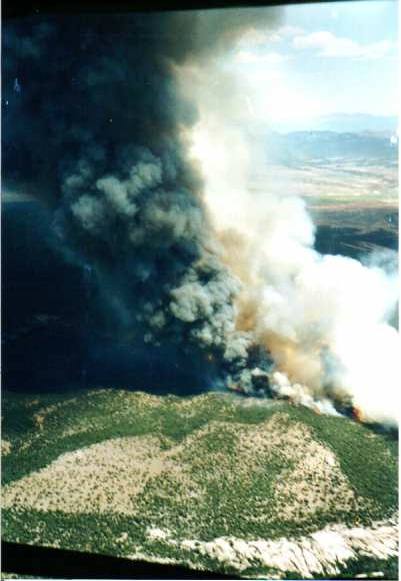
This photo taken from a Twin Otter aircraft shows a fire in Nevada, during the 2002 fire season. Smokejumpers often call this type of fire a “gobbler,” for the way it gobbles up everything in it’s path, including unwary firefighters. We picked a safe place to land, which was fortunate, because we were soon “burned over.” To be burned over means to be over-run by the fire. Because we knew this might happen, we selected a “safety zone” long before it was necessary. When the fire blew up, we withdrew to a previously burned area and watched the towering flames and smoke and listened to the roar of the fire.
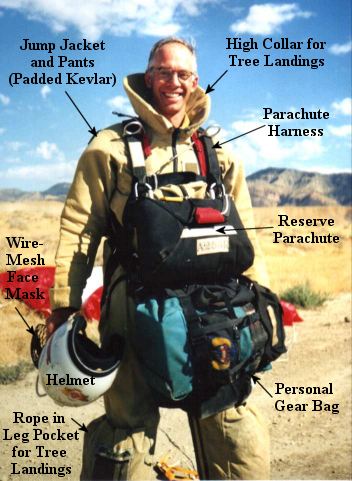
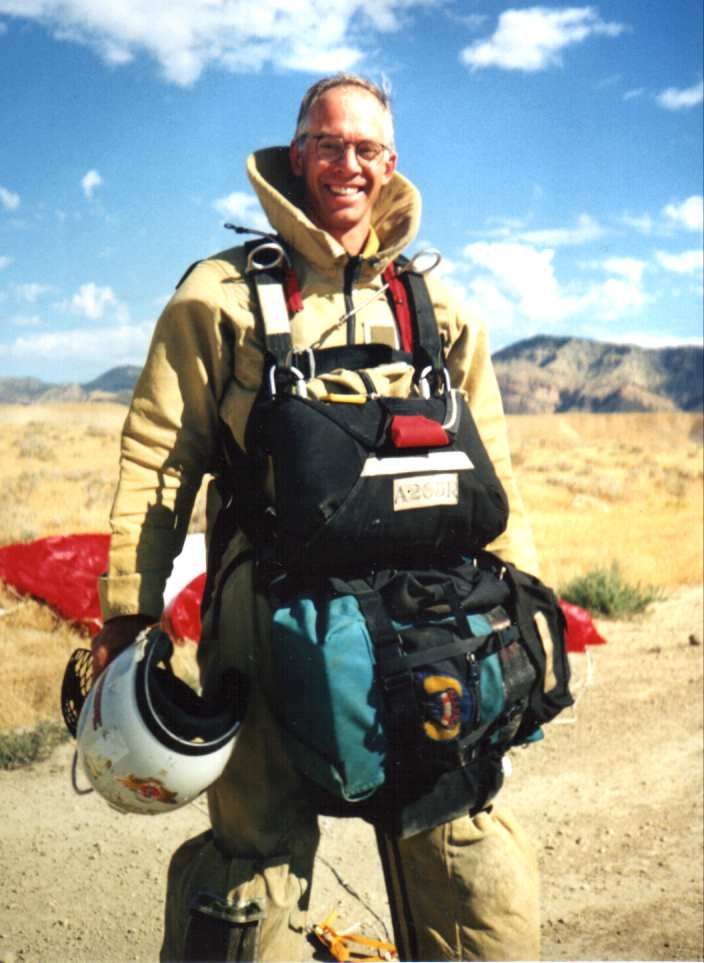
Smokejumpers wear a padded jump jacket and pants, made of Kevlar, the same material used for bullet-proof vests. A motorcycle style helmet is worn, featuring a heavy, wire-mesh face mask. (Above is a picture taken by Steve Baker right after I landed on a practice jump.) A small gear bag is carried by each smokejumper, in which are carried water, gloves, hardhat, fire shelter, and other personal belongings needed for a shift on the fireline. Heavier equipment is dropped separately. A “let-down” rope is carried in the right leg pocket in case it is necessary to rappel down out of a tall tree. Here is the above photo without text.
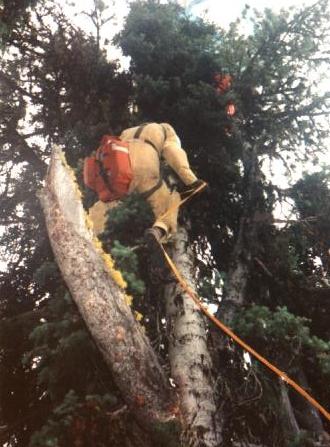
Here is a smokejumper doing a let-down on a fire jump in the Bitterroot Mountains of Montana. Smokejumpers find it is always a great deal more humorous to be the one standing on the ground hollering advice than to be the one hanging 100′ up in a giant Ponderosa!

There are two systems used, the round parachute by the Forest Service, and the square or “ram-air” parachute used by the BLM. This photo shows a practice jump with a ram-air parachute in the desert near Grand Junction, Colorado. (Photo by Dr. Steve Baker) Jumps are normally from 1,500 to 3,000 feet above ground level, in the safest spot that is nearby (not in) the fire. On most fires, two to eight smokejumpers are dropped, but additional smokejumpers or further reinforcements will be called in if necessary.

Usually smokejumpers reach fires while they are still small, using hand tools such as the shovel and pulaski. The pulaski is a single-bladed axe with a grub-hoe on the opposite side, and is, undoubtedly, the greatest fire handtool ever invented. The closest smokejumper in picture 7 is swinging a pulaski. Since he’s cutting into the ground, he’s using the grub-hoe side of the tool. If he were cutting branches, small trees, or even a large root in the ground, he’d flip the tool around and cut with the axe blade. Chainsaws are used (outside of wilderness areas) when needed. Trees, brush, and flammable debris are cleared along the edge of the fire to rob it of fuel and to stop the fire’s spread. The photo [taken with a flash] is of smokejumpers cutting hotline at night on a fire in Idaho.

Sometimes back-pack pumps are used, or power pumps are dropped if there is a handy water source. Fires in Alaska call for somewhat different tactics. The perimeter is usually secured by beating with burlap sacks, or a 6′ spruce tree limbed up to a “broom” shape, or with specially designed beating tools called “tony tools.” Here are smokejumpers at nightfall beating on a spring fire on Kodiak Island with tony tools and burlap sacks. Water is used when available, and chainsaws are often used to cut a fireline through the spruce trees.
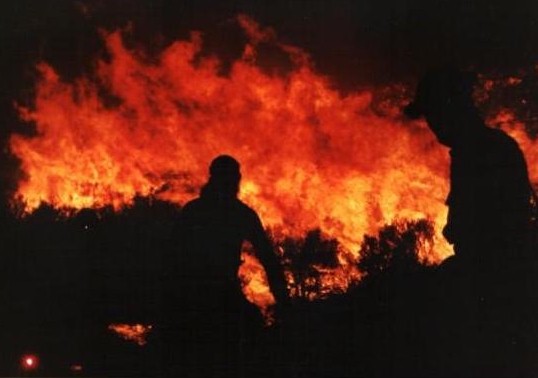
On any fire, a backfire, such as the one shown, is used if necessary. This is an especially common tactic in the big fast-moving fires of the “Great Basin” such as this one in Nevada. Often helicopters or fixed-wing aircraft (aka “air tankers”) are called in to aid the ground troops.Most smokejumper fires are out or turned over to other firefighters within 3 days, but smokejumpers have been known to spend over a month on fires. They are re-supplied by parachute, helicopter, or even by road if possible.

Smokejumpers may leave a fire by helicopter, on a four-wheel drive fire engine, or, if necessary, by packing up all their equipment and doing a “pack-out.” Packs average slightly over 100 pounds, but may weigh 120 pounds or more. Here smokejumpers drop out of the timber on a packout from a fire in the Wallowa-Whitman National Forest of NE Oregon. Unusually steep or non-existent trails have made many smokejumpers consider a career change.
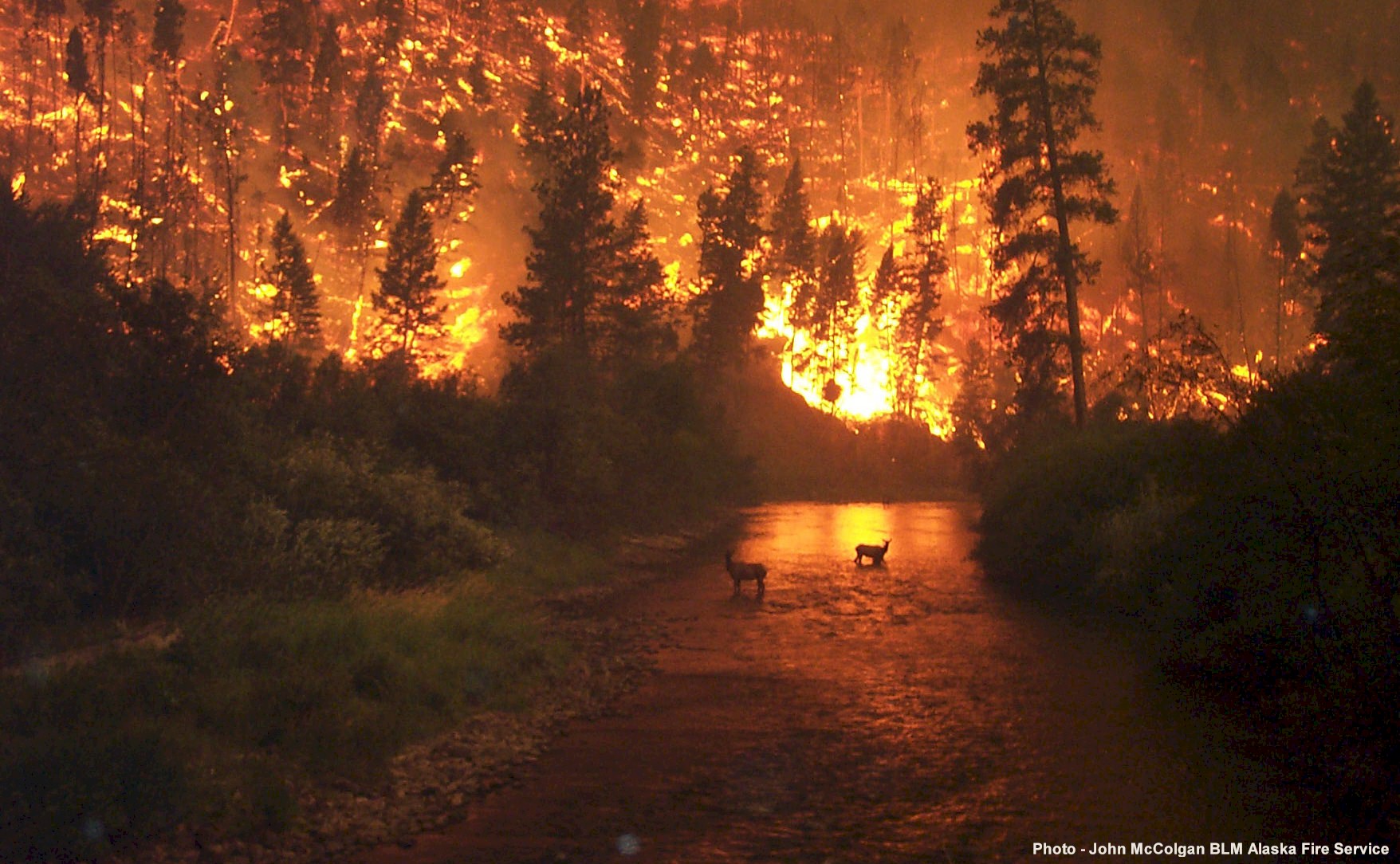
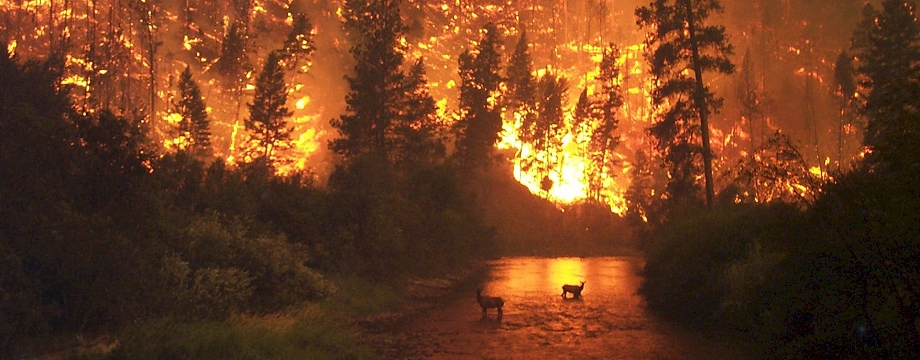
In this famous picture taken by Alaska smokejumper John McColgan in Montana in 2000, elk are taking refuge in a river to escape a large forest fire. Although many smaller animals perish in fires, larger animals, such as elk and deer, usually escape with little difficulty.
Smokejumpers are wildland firefighters who specialize in parachuting to fires in remote areas.
I have spent my smokejumper years at the Bureau of Land Management (BLM) base in Fairbanks, Alaska. There is one other BLM smokejumper base in Boise, Idaho. The rest of the bases are Forest Service bases, and they are located in Winthrop, Washington; Redding, California; Redmond, Oregon; McCall, Idaho; Grangeville, Idaho, Missoula, Montana; and West Yellowstone, Montana. During fire season, fire dispatch will send these jumpers to whatever region they are most needed. Every fire season temporary smokejumper bases are set up in such places as Silver City, New Mexico; Grand Junction, Colorado; and LaGrande, Oregon.
There are about 400 smokejumpers nationwide. There are also smokejumpers in Russia, and, off and on, in Canada.
Smokejumper training is intensive and consists of lots of physical fitness (PT) training as well as training in parachuting. The washout rate is often high, mostly due to injuries or failure to keep up in PT. There is a lot of competition to get into smokejumper training. Experience in fighting wildfires is a must, usually two or more years, and previous service on one of the elite “hotshot crews” increases a candidates chances of being selected.
Answers to commonly asked questions:
Isn’t it dangerous landing in a fire?
We land close to, not in, the fire. (at least that’s the plan, it’s not uncommon to land in smoldering areas.)
What happens if your parachute doesn’t open?
We use our reserve parachutes. Since 1940, only four smokejumpers have died during a parachute jump, a remarkable safety record.
What do you eat?
It depends on the jump base, but common foods include power bars, canned fruit, beef jerky, nuts, MREs (military Meals Ready to Eat), candy bars, small cans of tuna or chicken or ham, freeze-dried meals, ramen, energy drink mixes, canned chili, condensed soup, etc. Often the smokejumpers get to choose what goes into the boxes, so as tastes change, so do the box contents.
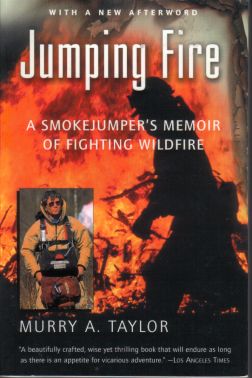

Excerpt from Jumping Fire: A Smokejumper’s Memoir of Fighting Wildfire
Prologue
The door of Jump 17 opens to an unnerving roar, swings aside, and reveals four hundred acres of fire crowning in black spruce. Orange tongues of burning gases lick high into the air. Coils of black smoke roll up from a flame front a mile wide. At the fire’s head, flames eighty feet high whip back and forth as if trying to tear themselves free from the earth. At fifteen hundred feet, we orbit and look down. The smoke column rises out of a blue-green landscape to tower above us, its lower third brown and black, its middle a marbled yellow-gray, its top a crown of sunlit silver.
Air rushes into the airplane–thin mountain air, sweetly laced with the scent of wood smoke. The roar is so loud we can barely shout above it. Hitting turbulence, we bounce weightlessly, then slam down on the cargo. From the pit of my stomach nausea flows through the rest of my body. My breathing is rapid and shallow, tightly constrained by the chest strap on my jump harness. I struggle to my feet, grab the overhead cable, and make my way to the door. We have an eight-man load. I will jump first.
Jump 17 lines up for our initial pass over the jump spot. Dalan Romero drops the first set of drift streamers. Banking into a turn, we watch the streamers–one red, one blue, and one yellow–flutter brightly against the backdrop of the dark forest, then suddenly waver, tumble end over end, and sweep in toward the fire. We make a second pass to drop another set. They do the same.
I watch through the door as the fire crests a ridge . . . Grave, but apparently satisfied with what he’s seen, [Dalan] shouts over his headset to the pilots, “Take us to three thousand.”
Dalan turns to me, holding up two fingers, and I step closer to the door and brace myself, being careful not to get sucked out by the slipstream. Kubichek, my jump partner, takes his place inches behind me.
“Looks like about five hundred yards of drift,” Dalan yells. “The winds are tricky down low. Stay wide of the fire. The jump spot’s in the shadow of the column there in that little meadow just north of the barn. Do you see it?”
I nod yes.
Again Dalan’s head is out the door and looking forward under the plane. I hear the pilot over the intercom. “We got three thousand, Dalan, we got three thousand.” Dalan says something back into his headset, and then his eyes are back on me.
“OK, two jumpers,” he commands. “Are you ready?”
I nod yes.
“Get in the door.”
I drop into a sitting position, my legs hanging out into the slipstream. Kubichek is close behind, waiting. Sitting there in the door, even though the fire is more than a mile away, I can feel the heat on my face.
Again Dalan’s head is out and looking. My field of vision fills with a panorama of the Alaska Range. The land below runs in a flat incline, rising east to the cloud-shadowed foothills of the Toklat River Valley. Beyond the hills, thrusting up out of the earth, is a world of jagged black peaks, blue ice walls, and massive snowfields–the heart of Denali National Park, a stronghold left over from the Ice Age, at once forbidding and magnificent.
Dalan pulls his head in, shoots me a quick glance, then raises his arm behind my back. “Get ready!”
The slap comes down hard on my shoulder, and I propel myself forward with all my strength. In the next instant I am out and counting.
“Jump-thousand, look-thousand . . .”_
The earth and the sky revolve in a blur of tilted horizons, aircraft wings, greens, blues, and rushing noise. My body pitches sideways to the right as I watch my boots fly higher than my head. I fall downward at ninety miles per hour. The forest, the fire, and the mountains rotate in a spin below. I look up as Kubichek clears the door–he, too, becomes a dark silhouette tumbling in the blue.
“Reach-thousand . . .”
My right hand reaches for the green rip cord. My fingers curl around it tightly.
“Wait-thousand . . .”
I am aware of what hangs in the balance of the next few seconds. Resisting the temptation to pull early, I wait out that odd, warped moment when time stretches, then begins to tear.
“Pull-thousand . . .”
My hand pulls right across my chest and shoots out to the side. I feel myself tilt forward, then a tugging sensation across my shoulders, and the chute is off my back and struggling to open. Tossing my head back, I watch, and there it comes, billowing into a gleaming rectangle of brilliant orange and white. In the aftermath of the roar there comes a startling silence.
I check the rear corners of my chute for tension knots, then reach for my steering toggles, pull down left, and come around into the wind. I look down. The head of the fire has temporarily halted along the crest of the ridge while the ground fire spills down into the valley.
Kubichek lets out a long, whooping yell. He, too, has just opened. I yell back, then turn and try to orient to the jump spot.
The smoke column rises high overhead, casting an ominous shadow far over the land. Facing into the wind, I try to locate the jump spot. I feel my gut tighten as I watch the ground pass below, appearing to surge one way and then the other as the chute rocks back and forth. Pulling down on the left toggle, I begin moving closer to the wind line. Still, I can’t make out the jump spot. I yell at Kubichek that I can’t see the spot. He yells something back and starts laughing.
Lightning arcs down out of the top of the smoke column and strikes the ground between me and the fire. Thunder cracks loudly, trailing off in a rumble. Sunlight streams down through a hole in the smoke to pool green and gold upon the land as it might on the floor of a cathedral. A small sunny meadow appears. Kubi and I yell out in unison. In that moment I feel as if I can fly on and on forever, sailing high above all the great forests and wilderness on earth, out beyond the farthest horizon, into the infinite darkness to drift among the stars.
Other Smokejumper Links
How can I become a Smokejumper? Advice on getting into Alaska Smokejumper training. Wildfire experience is needed.
Click here to visit Mike McMillan’s smokejumper page. If you want to see some great smokejumper photos, this is the place to go.
Click here to visit the official National Smokejumper Association Webpage. It’s a great source of smokejumper information and news.
Smokejumper Base Websites
Smokejumper Base Contact Information
Alaska Smokejumpers
Boise Smokejumpers
McCall Smokejumpers
Missoula Smokejumpers
North Cascades Smokejumpers
Redding Smokejumpers
Redmond Smokejumpers
???Questions???
If you still have questions after researching the above sites, I’d be happy to answer them if I can.
In Memory of my friends
Dave Liston, Alaska Smokejumper
Jim Thrash, McCall Smokejumper
and for all the other Bros who have lost their lives while smokejumping…
-They Lived the Dream-

Excellent info. I’ve been a wildland fire fighter in R9 for 7 seasons, have ENGB, ICT4 and FALC, with several western assignments in there. With such experience would you think these are enough quals/experience to get into rookie training? Also, do you know of jumpers that support a family on the salary they make along with insurance? I know last year the feds opened up temp fire to health insurance.
thanks for whatever info you may have.
Hi Ed,
It is really competitive to get into rookie training. You should have plenty of experience to qualify IF you impress the people making the selections that you will make an unusually good smokejumper. That means, among other things, a reputation as an outstanding, hardworking firefighter with good judgment. I’d suggest applying and see how it goes. If my goal was becoming a smokejumper, I’d definitely apply to get on a western hotshot crew and work my butt off and respectfully make it known in the smokejumping world that I wanted to become one. Smokejumping isn’t lucrative but there are many smokejumpers who support families.
Good luck!
Buck
I’ve always been curious as to what smokejumpers and wildland firefighters do in the offseason since most of the employment in seasonal. I’ve been wanting to get into this for a while now but I’m a little unnerved not knowing how to make a living at this. Coming from Kentucky, I don’t have any exposure to this life. Thanks.
Traditionally many smokejumpers went to school, skied, had winter jobs or traveled during the winter. That is still largely true. I, for example, worked about 9 months a year for most of my career, making and repairing gear when there were no fires. In the off season I traveled, hunted, fished, wrote or worked on other projects. A few make firefighting a year-round job. It’s not uncommon to make 400-1,000 hours of overtime during fire season, so some people are working nearly a full year in perhaps 6-9 months.